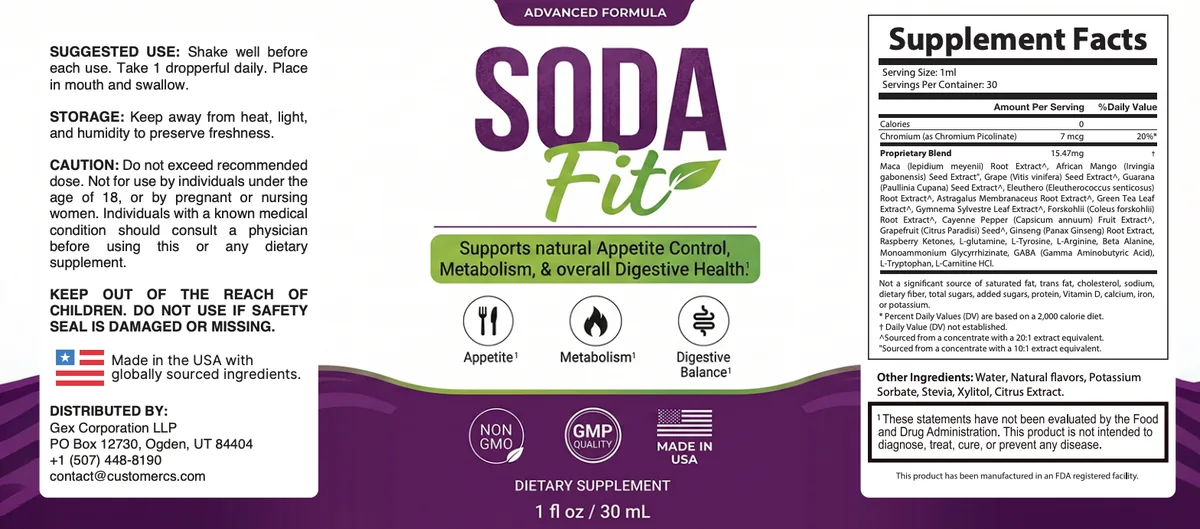
SodaFit® Ingredients & Supplement Facts
One section for each ingredient, with the research linked at the end — and, every time the label does not publish an amount, a sentence saying so. That happens twenty-one times out of twenty-two.
Chromium In SodaFit® (as chromium picolinate)
Chromium is a trace mineral. You get small amounts from meat, wholegrains, broccoli and a long list of ordinary foods, and the body needs very little of it. On this label it appears as chromium picolinate, the form most commonly used in supplements because it absorbs better than chromium found naturally in food.
Its recognised role is in normal macronutrient metabolism — the everyday business of handling carbohydrate, fat and protein. That is a real, established function rather than a marketing phrase, and it is the reason chromium turns up on so many weight-management labels.
Be careful about what that means, though. Chromium has been studied for blood sugar and for appetite, and the results across those trials are mixed — some show small effects, several show none, and the doses used vary widely. 7 mcg is 20% of a daily value, which is a genuine nutritional contribution and considerably less than the amounts used in most of the research. It is the one number on this panel you can check, and we would rather you checked it than took our word for it.
Where to read more
The SodaFit® Proprietary Blend, And What It Hides
Everything else in SodaFit sits inside a single line on the panel: Proprietary Blend, 15.47 mg, followed by twenty-one ingredients in a list. There is no amount beside any of them.
This is a legal and extremely common way to write a supplement label. It stops a competitor reading your recipe off the bottle. It also means that neither you, nor a review site, nor this page can say whether the green tea extract in a serving is 5 mg or 0.5 mg. Anyone who prints a figure for it is guessing, and a guess presented as a fact is the thing we are trying not to do here.
There is one thing you can read from it. Supplement labels conventionally list blend ingredients in descending order by weight, which puts maca root at the top and L-carnitine HCl at the bottom. That is a convention rather than a rule and the label does not state it, so treat it as a hint about proportions and nothing more.
The other thing worth holding on to: 15.47 mg is a small total. Spread across twenty-one ingredients it means each one, on average, is well under a milligram. Much of the published research on these botanicals works in hundreds of milligrams or in grams. That gap is the honest context for the whole label, and it is why this page sells the routine, the format and the guarantee rather than a promise about what the blend will do.
Where to read more
Maca Root Extract In SodaFit® (Lepidium meyenii)
Maca is a root vegetable grown high in the Peruvian Andes, eaten as food there for centuries and sold as a supplement everywhere else. It is listed first in this blend, which by the usual labelling convention makes it the likeliest largest share of the 15.47 mg.
It is most often studied for energy and mood rather than for appetite, and the research base is small — a handful of modest trials, usually using powdered root in gram quantities. Nothing in that literature involves an amount a 15.47 mg blend could contain.
It is included here as a general tonic botanical, and that is the most accurate way to describe it.
Where to read more
African Mango Seed Extract In SodaFit® (Irvingia gabonensis)
African mango is the ingredient most buyers recognise on a weight-management label, and it earned that recognition through a small number of trials in the late 2000s that reported effects on weight and waist measurements.
Those trials have been criticised since — small samples, short durations, industry funding, and results that have not been reliably repeated by independent groups. Systematic reviews since have called the evidence insufficient rather than negative, which is a different and more honest thing than either the marketing or the debunking suggests.
The trials that reported anything used standardised extract at 150 mg twice a day. This blend is 15.47 mg in total for twenty-one ingredients, so the amount of African mango here cannot approach that. We think you should know that before you order rather than after.
Where to read more
Green Tea Leaf Extract In SodaFit® (Camellia sinensis)
Green tea leaf extract is the best-studied ingredient in this blend by a wide margin. Its catechins, particularly EGCG, have been examined for metabolic rate and fat oxidation in dozens of trials, and it carries caffeine, which is itself a mild and well-documented metabolic stimulant.
The honest summary of that literature is that effects on body weight are small, inconsistent, and most visible in people who do not already consume much caffeine. The doses used typically run from 250 mg to over 1,000 mg of extract a day.
The safety note matters more than the efficacy note here. Green tea extract is one of two caffeine sources in this formula, and the label does not disclose the caffeine content. Concentrated green tea extract has also been associated, rarely, with liver injury — a risk that rises with high doses taken on an empty stomach. At the amounts a 15.47 mg blend can hold, that is unlikely to be a concern; we mention it because a page that only lists benefits is not telling you the whole label.
Where to read more
Guarana Seed Extract In SodaFit® (Paullinia cupana)
Guarana is an Amazonian climbing plant whose seeds carry caffeine at a higher concentration by weight than coffee beans do. In practical terms, guarana on a label means caffeine on a label.
It is included in formulas like this one for the same reason coffee is in your morning: caffeine reliably increases alertness and modestly increases energy expenditure. That part is not controversial.
What is not on the label is how much. With green tea extract also present and neither amount disclosed, nobody can tell you the caffeine in a serving of SodaFit. If you are caffeine-sensitive, pregnant, nursing, on medication, or managing a heart or blood-pressure condition, that unknown is a reason to speak to a doctor before ordering rather than a detail to skim past.
Where to read more
Grape Seed Extract In SodaFit® (Vitis vinifera)
Grape seed extract is a source of proanthocyanidins, a family of plant polyphenols that also turn up in red wine, cocoa and green tea. It is one of the more commonly supplemented antioxidant botanicals.
Most of the research on it concerns blood pressure and vascular measures rather than appetite or weight, and the trials generally use 100 to 300 mg a day. As with everything else in this blend, the amount here is not published and cannot match those figures.
It sits on this label as a polyphenol contributor. That is a reasonable thing for a formula to include and a poor thing for a page to build a promise on.
Where to read more
The Other Fifteen Ingredients On The SodaFit® Panel
Beyond the six above, the blend lists: eleuthero root, astragalus membranaceus root, gymnema sylvestre leaf, coleus forskohlii root, cayenne pepper fruit, grapefruit seed, panax ginseng root, raspberry ketones, L-glutamine, L-tyrosine, L-arginine, beta-alanine, monoammonium glycyrrhizinate, GABA and L-tryptophan.
They fall into three rough groups. Traditional botanicals — eleuthero, astragalus, ginseng — used as adaptogens in herbal traditions, with a research base that is broad but thin. Metabolic and appetite names — gymnema, forskohlii, cayenne, raspberry ketones, L-carnitine — each with its own small literature, mostly at doses far above anything a 15.47 mg blend contains. Amino acids and related compounds — glutamine, tyrosine, arginine, beta-alanine, GABA, tryptophan — which in supplement research are normally dosed in grams, not fractions of a milligram.
One that deserves a specific note: monoammonium glycyrrhizinate is a licorice-derived compound. Licorice in quantity can raise blood pressure and lower potassium, which is why it carries warnings at high intakes. At a share of 15.47 mg that is not a realistic concern — but if you take blood-pressure medication, it belongs in the conversation with your doctor along with the rest of the label.
We are not going to write a paragraph of benefits for each of these. At undisclosed fractions of a small blend, the honest thing to say is that they are present, that each has its own literature at its own dose, and that none of that literature studied this product.
Where to read more
The Rest Of What Is In A SodaFit® Bottle
Other ingredients, printed on the panel: water, natural flavors, potassium sorbate, stevia, xylitol and citrus extract. Potassium sorbate is a preservative; stevia and xylitol are the sweeteners, which is how a serving lands at zero calories.
Suggested use, as printed: shake well before each use, take one dropperful daily, place in mouth and swallow. Caution, as printed: do not exceed the recommended dose, not for use by anyone under 18 or by pregnant or nursing women, and individuals with a known medical condition should consult a physician before use.
Manufactured in the USA with globally sourced ingredients, in an FDA-registered facility working to GMP standards. FDA registration of a facility is a manufacturing requirement and is not FDA approval of this product. Distributed by Gex Corporation LLP, Ogden, Utah.
Every paper linked on this page examined a single ingredient at its own dose. None of them studied SodaFit. These statements have not been evaluated by the Food and Drug Administration. This product is not intended to diagnose, treat, cure or prevent any disease, and it is not a weight-loss drug.